
Ribbon mixers are common equipment in powder mixing workshops. They consist of a U-shaped trough with inner and outer spiral ribbons coiled inside; once the machine is started, the material tumbles and circulates within the trough. The question operators are most concerned about is often very straightforward: How long does this batch need to run before it’s thoroughly mixed?
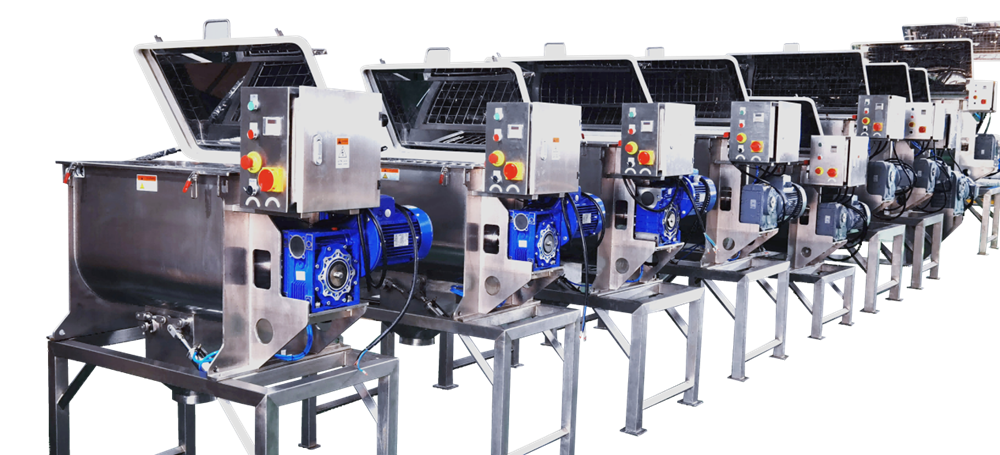
The answer is typically 1 to 15 minutes; larger machines require 20 to 25 minutes.
This time range may seem broad, but there is a clear logic behind it. To understand it, we need to examine three aspects: how the machine works, what factors influence it, and how to determine the mixing time in actual production.
I.How the Machine Works
The core of a ribbon mixer consists of two layers of spiral ribbons—an inner and an outer layer. The outer ribbon pushes the material from both ends of the trough toward the center, while the inner ribbon pushes the material from the center back toward the ends. These two opposing material flows create a convective circulation within the trough. The material does not gradually diffuse on its own but is folded and repositioned in large chunks.
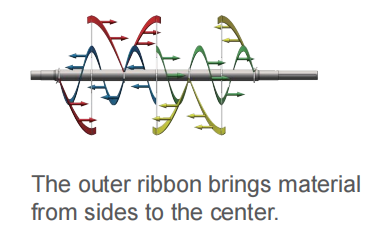
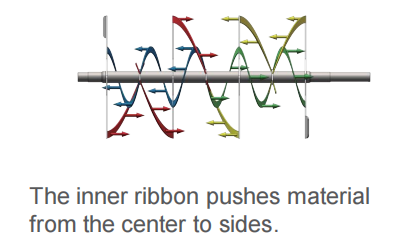
This mechanism yields an empirical rule: it takes approximately 100 revolutions to achieve uniformity. Typical rotational speeds range from 20 to 40 revolutions per minute, so the actual mixing time is often only 3 to 5 minutes. This is the fundamental reason for the ribbon mixer’s high efficiency.
II.What Influences the Time
Equipment size is the most obvious factor. A small batch of 1 cubic foot takes about 2 to 3 minutes; 18 cubic feet takes about 8 to 10 minutes; and 100 cubic feet takes about 20 to 25 minutes. The larger the equipment, the greater the distance the material must travel to complete a convective cycle, naturally increasing the time required. At the same time, larger equipment typically operates at more conservative speeds, which also extends the mixing time.
Material properties are equally critical. Materials with similar particle sizes and densities mix the fastest. If fine powders and coarse particles are present together, the tendency for segregation will compete with the mixing process, forcing the time to be extended. When liquid must be sprayed onto the material, additional time is required for the liquid to disperse and penetrate the particle surfaces, resulting in a longer mixing time than for pure dry mixing.
The load volume also directly affects efficiency. The optimal load volume is 40% to 70% of the total capacity. If the load is too small, the ribbon will not come into contact with all the material; if it is too full, the convection space is compressed. Both situations will prolong the mixing time.
III.How to Determine This in Actual Production
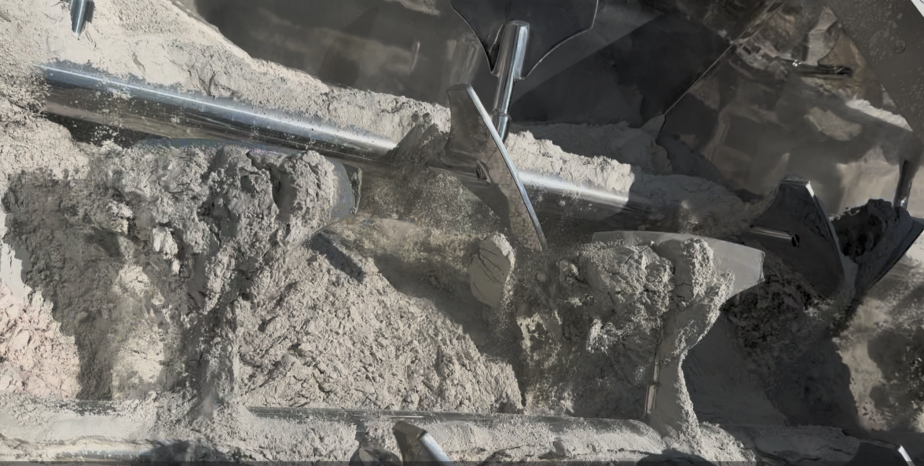
Empirical formulas can only provide a rough range; the specific time should be determined through sampling tests. During the mixing process, take samples from different locations every few minutes and measure the concentrations of key components. When the fluctuations in concentration at each point stabilize and no longer decrease, the corresponding time is the optimal mixing time.
This approach not only prevents quality fluctuations caused by insufficient mixing but also avoids segregation and wasted energy resulting from overmixing.
Post time: Sep-28-2026