
The ribbon mixer is a new type of mixing equipment characterized by high efficiency, high uniformity, low energy consumption, low pollution, and low breakage. Its unique double-ribbon design enables materials to be mixed evenly in a short time.
The ribbon mixer is mainly used for mixing dry powders with powders, powders with granules, and also achieves good mixing results when powders are mixed with a small amount of liquid. It is widely used in pharmaceuticals, food, daily chemicals, pesticides, chemicals, fragrances, and many other fields.
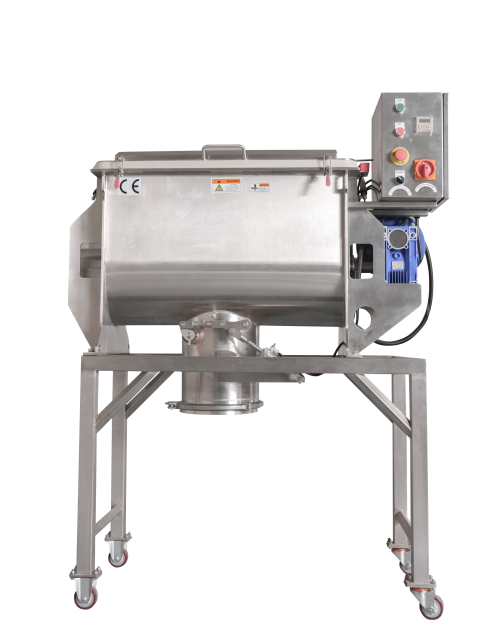
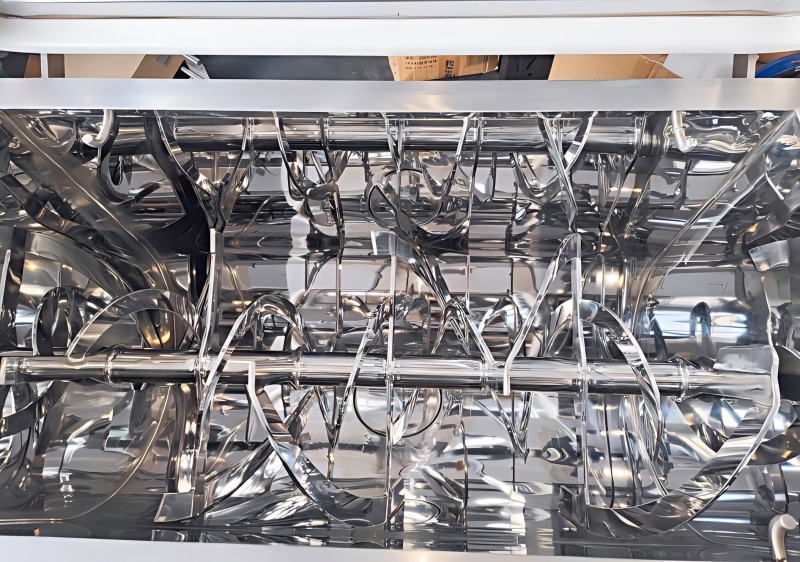
The ribbon mixer mainly consists of a U-shaped cylinder, ribbon mixing blades, and transmission components. The overall structure is simple, the operation is stable, and maintenance is convenient. The mixer’s main shaft typically has two sets of inner and outer double-layered ribbons running in opposite directions. During operation, the outer ribbon transports material from both ends to the middle, while the inner ribbon transports material from the middle to both ends, forming a continuous convection circulation.
Cover: Features a reinforced bent-structure design that reduces the weight of the cover while maintaining its structural integrity and enhancing its load-bearing capacity.
Rounded-Corner Design: Ensures operator safety when opening the top cover.
Silicone Ring: Primarily serves a sealing function; the elastic nature of the silicone also acts as a buffer, protecting both the operator and the top cover from impact. Furthermore, it is easy to replace, facilitating simpler maintenance and cleaning.
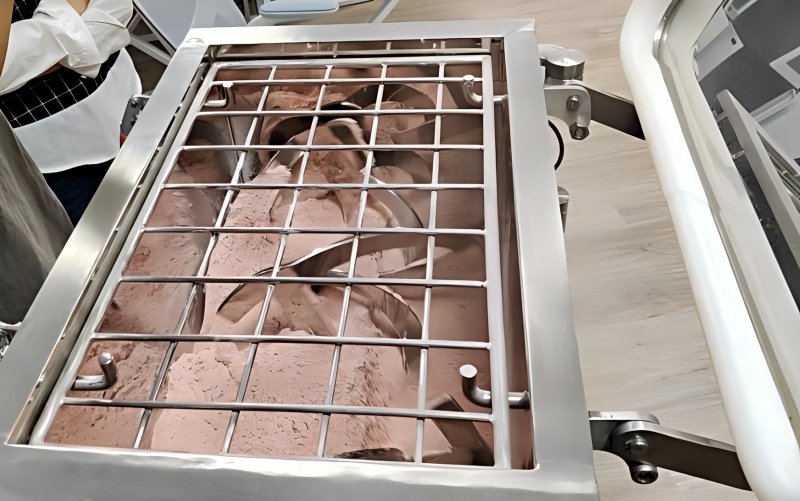
The interior of the silicone seal features a threaded design, ensuring it remains securely in place and further enhancing the sealing performance.Feeding port and safety net: The feeding port cover is designed as a fully opening door for easy cleaning and manual feeding. The safety net prevents operators from accidentally touching the ribbons and prevents foreign objects from falling in.
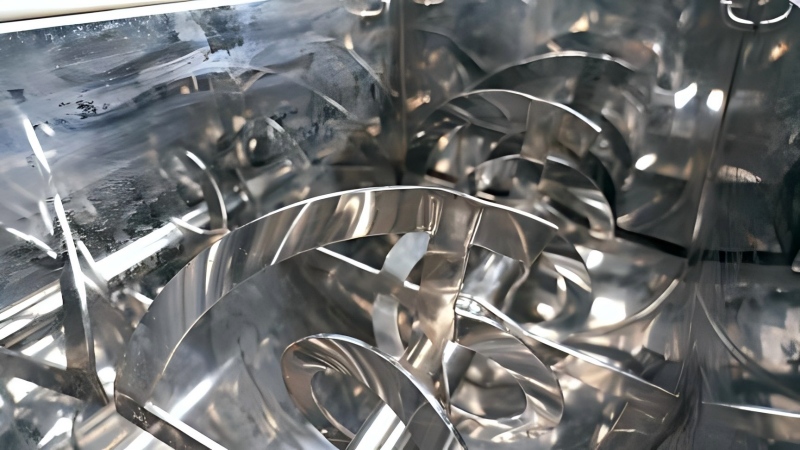
U-shaped trough: Generally made of 304 stainless steel, but 316 stainless steel is also an option. The inner surface is smooth, with an arc-shaped design for easy material discharge, reduced dirt buildup, and easy cleaning.
Shaft and spiral ribbon: The shaft runs through the center of the trough, and the spiral ribbon is divided into large and small sections, structurally forming counter-spirals. This creates more vortices during mixing, accelerating the mixing speed.
Hydraulic Strut: Also known as a gas spring, it primarily facilitates a smooth, controlled lift, enabling the lid to open automatically with minimal physical effort.
Safety interlock: When the lid is opened, the ribbon agitator immediately ceases operation, serving as a power cut-off mechanism. The machine stops instantly upon opening the lid.
Packing Seal: Utilizes PTFE sealing rings to effectively prevent powder leakage.
Motor: The motor drives the central shaft and spiral ribbon to rotate, causing the material in the trough to tumble. This tumbling motion produces the necessary material tumbling and folding effects for mixing. A frequency converter can also be added to adjust the speed of the spiral ribbon mixer according to different products.
Discharge port: The bottom of the cylinder is fully welded. The silicone interlayer in the middle acts as a seal to prevent leakage. The valve flap at the discharge port perfectly matches the curvature of the cylinder, resulting in excellent sealing and preventing leakage.
The ribbon mixer mainly relies on three mixing methods: convection, shear, and diffusion. Among them, convection is dominated by the spiral ribbon, which is responsible for transporting materials over a large area; shearing is used to break up local agglomerates; and diffusion achieves uniform distribution between particles at the microscopic level.
Compared to other common industrial mixers, ribbon mixers offer several distinct advantages.
Low Energy Consumption: Thanks to their efficient convective action, ribbon mixers can typically achieve the same mixing results in less time and with lower energy consumption than V-mixers or double-cone mixers.
Minimal Particle Breakage: Unlike high-speed mixers or hammer mills, the gentle tumbling action of the ribbon blades does not crush fragile materials. This makes them an ideal choice for preserving the integrity of crystals, flakes, or coated particles.
Low Contamination Risk: The smooth interior surfaces are easy to clean and inspect—a critical requirement for food and pharmaceutical manufacturing.
Liquid Addition Capability: Small amounts of liquid can be sprayed onto the powder bed during the mixing process. The ribbon blades effectively distribute the liquid evenly without forming wet clumps.
Post time: Apr-11-2026