
In industries such as pharmaceuticals, food processing, cosmetics, and chemicals, the horizontal ribbon blender is a widely used mixing solution. Through the rotation of inner and outer ribbon blades, the mixer creates continuous convection and circulation, achieving a uniform mixture of powders, granules, and other materials.
When selecting a ribbon mixer, manufacturers usually provide two common stainless steel options: SS304 and SS316. Although both are stainless steels, the difference in their alloy composition directly affects corrosion resistance, equipment durability, cleaning requirements, and suitability for different production environments.
For ribbon mixers, stainless steel selection mainly applies to product-contact parts, including the mixing trough, ribbon blades, shaft, and discharge components. Choosing the appropriate material helps ensure product safety, stable operation, and longer equipment lifespan.
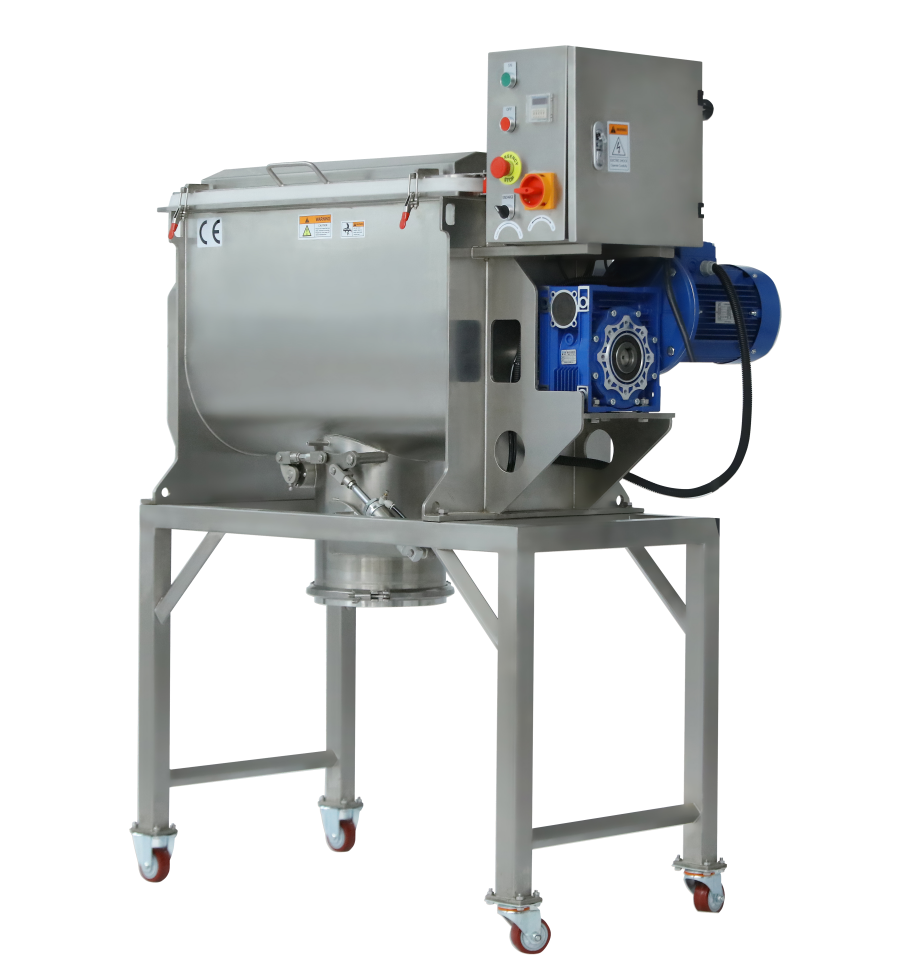
SS304: The “All-Rounder” for General Applications
SS304 stainless steel is the most widely used grade and is considered the standard configuration for many ribbon mixers. It provides a good balance of corrosion resistance, mechanical strength, durability, and cost-effectiveness, making it suitable for most general mixing applications.
In the food industry, SS304 ribbon mixers are commonly used for dry powders such as flour, milk powder, sugar, and spices. In chemical applications, they can handle many non-highly corrosive materials, including pigments, coatings, and plastic pellets.


Industry Standard Classification
SS304 is widely accepted for many food processing and general industrial applications when proper surface finishing and hygienic manufacturing processes are applied. Its corrosion resistance is sufficient for handling neutral or mildly acidic and alkaline materials, as well as routine cleaning procedures during daily production.
For most standard operating conditions, SS304 ribbon mixers provide a practical balance between performance, reliability, and investment cost.
However, when materials contain high levels of salt, chlorides, or corrosive components, SS304 may not provide sufficient protection against long-term corrosion. In these cases, SS316 becomes a more suitable option.
SS316: The “Specialist” for Harsh Conditions
When production processes require higher corrosion resistance and stricter hygiene standards, SS316 stainless steel becomes the preferred choice.
The key difference between SS304 and SS316 is the addition of molybdenum (Mo) in SS316. This element significantly improves resistance to chloride ion corrosion, pitting corrosion, and crevice corrosion, making SS316 more suitable for challenging production environments.
A Leap in Corrosion Resistance
This advantage is particularly important when ribbon mixers are used for materials containing salt, chlorides, or corrosive chemical components.
For example, SS316 ribbon mixers are often selected for:
- ✔ Salt-containing products
- ✔ Acidic or alkaline formulations
- ✔ Corrosive chemical powders
- ✔ Applications requiring frequent cleaning with aggressive chemicals


Compared with SS304, SS316 provides better protection against corrosion damage, helping reduce maintenance requirements and extending equipment service life.
In pharmaceutical, biotechnology, cosmetics, and high-hygiene industries, SS316L is often preferred because its lower carbon content provides better weld corrosion resistance after fabrication. This makes it suitable for applications requiring strict cleaning validation, high surface finish standards, and reduced contamination risks.
It is important to note that GMP compliance itself does not automatically require SS316. The appropriate material selection depends on the product characteristics, cleaning procedures, regulatory requirements, and overall production environment.
Application Scenarios: How to Choose?
Selecting between SS304 and SS316 ribbon mixers requires a comprehensive evaluation based on material properties, industry requirements, cleaning methods, and the equipment’s total lifecycle cost.
For food and general chemical applications, SS304 is sufficient:
If your production mainly involves dry powders or granules, with neutral or mildly acidic/alkaline materials, and without high salt or chloride content, an SS304 ribbon mixer can fully meet your production needs.
It provides reliable performance, easy maintenance, and excellent cost-effectiveness, making it a popular choice for general food processing and standard industrial applications.
Pharmaceuticals, Cosmetics, and Highly Corrosive Environments: Choose SS316/SS316L
For industries with stricter requirements regarding product purity, contamination control, and corrosion resistance—such as pharmaceuticals, cosmetics, biotechnology, and fine chemicals—SS316 or SS316L is usually the better choice.
Although the initial investment is higher, the improved corrosion resistance can help prevent equipment damage, production interruptions, and potential product contamination caused by corrosion. Therefore, SS316/SS316L often provides better long-term value in demanding applications.
Post time: Oct-26-2026