
Powder mixing is a core process in the food, pharmaceutical, chemical, and new energy materials industries. As production scale increases, the key to selecting the right equipment is no longer simply “whether it can mix uniformly,” but rather a comprehensive balance between loading capacity, mixing efficiency, and process integration.
1 Batch Mixing
In batch mixing, a batch of material is loaded all at once, mixed, and then discharged as a whole. Its advantages include flexible formulations and batch traceability, making it suitable for multi-product production. However, as production scale increases, equipment size, drive power, and mixing time all increase simultaneously, leading to a significant rise in energy consumption and floor space requirements.
2 Continuous Mixing
Continuous mixing involves continuous metered feeding, with the material being continuously discharged after mixing. Its core advantages include a small mixing chamber, short residence time, and low energy consumption per unit of output. However, mixing quality is immediately affected by any fluctuations in feed rate, making it highly dependent on high-precision loss-in-weight feeders.
The Main Model in Batch Processing
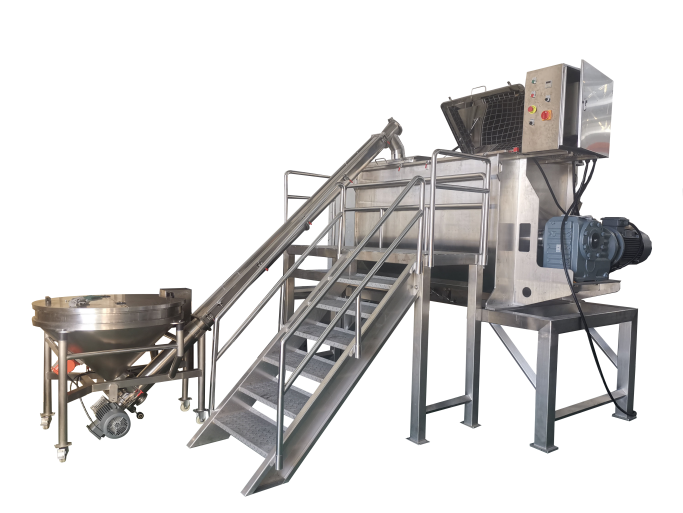
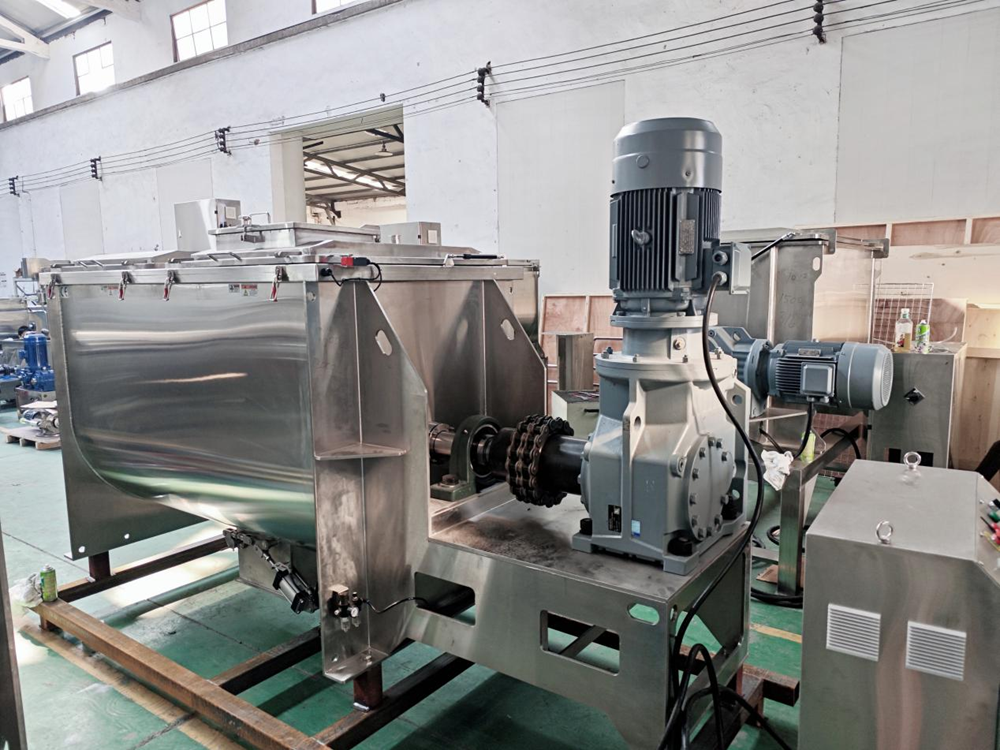
Horizontal Screw Ribbon Mixer
The horizontal screw ribbon mixer is a classic choice for high-throughput applications. Within a U-shaped horizontal drum, two layers of screw ribbons—inner and outer—propel the material in opposite directions: the outer ribbon pushes the material toward the center, while the inner ribbon pushes it back toward the sides, creating a convective circulation. Its loading factor typically ranges from 50% to 70%, and the working volume of a single unit can reach up to 1,000 cubic feet (approximately 28 cubic meters). It features short mixing times and is highly efficient for free-flowing powders; however, its drawbacks include relatively high residuals and cleaning that is less convenient than with conical equipment.
Plow-blade Mixer
Plow-blade mixers utilize a horizontal cylinder and specially arranged plow-shaped agitator blades. The high-speed rotation of the blades creates a “mechanical fluidized bed” inside the cylinder, keeping all material particles in constant motion. They offer high mixing intensity and are suitable for materials with significant differences in specific gravity or those requiring the addition of liquids. The flying knife assembly breaks up agglomerates and enhances the dispersion of trace components. These mixers are widely used in large-scale production in industries such as building materials, friction materials, and animal feed.
Gyraton-type Oscillating Mixer
For extremely large batch capacities, the Gyraton-type oscillating mixer offers a compact solution: the central agitator performs a circular oscillating motion, enabling a single-batch capacity of 70–100 cubic meters while requiring only a fraction of the drive power of conventional models. It is suitable for high-value powder applications where factory ceiling heights are limited but large-volume processing is required.
Post time: Sep-30-2026