
Three steps, one density figure
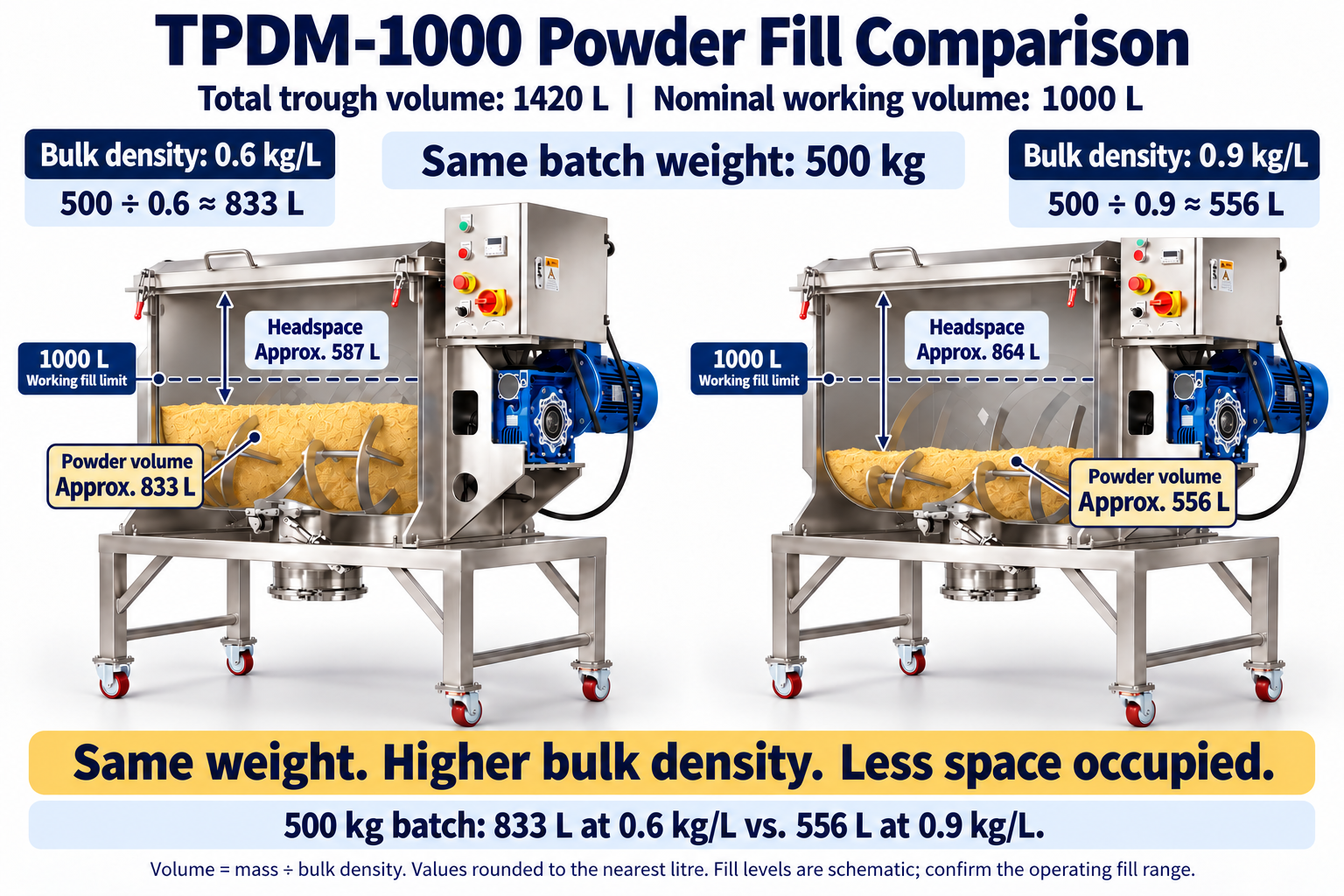
Working volume is 500 kg ÷ bulk density in kg/L. At 0.6 kg/L, that is approximately 833 L; at 0.9 kg/L, it is approximately 556 L. The TDPM-1000 has a nominal working capacity of 1,000 L and a total trough volume of 1,420 L. These two powders therefore occupy approximately 58.7% and 39.1% of the trough, respectively. The higher-density powder’s lower fill level should be checked against the mixer’s minimum operating fill.
That third step is where many first enquiries go wrong. Buyers may confuse nominal working capacity with total trough volume. For the TDPM-1000, 1,000 L of powder occupies approximately 70% of its 1,420 L trough—not more than 80%.
The same 500 kg can need 500 L or 2,000 L
| Bulk density | Working volume | Model | Trough volume | Fill achieved |
|---|---|---|---|---|
| 0.30 kg/L — very light, bulking | 1,667 L | TDPM-2000 | 2,500 L | 67% |
| 0.50 kg/L — flour, milk powder | 1,000 L | TDPM-1500 | 1,875 L | 53% |
| 0.65 kg/L — starch, sugar blend | 769 L | TDPM-1000 | 1,250 L | 62% |
| 0.80 kg/L — detergent, mineral | 625 L | TDPM-1000 | 1,250 L | 50% |
| 1.20 kg/L — heavy mineral, oxide | 417 L | TDPM-500 | 710 L | 59% |
What else moves the answer
Whether 500 kg is one batch or one shift matters more than anything else after density. At 500 kg per shift, a 150–200 L machine running three or four batches may cost less and clean faster than one large unit. Beyond that: does the recipe take sprayed liquid (which pushes fill down to 30–50%), what hygiene level is required (304 or 316L, polish, seal type), and how does product leave the machine — a full-length gate into drums, or a screw discharge into a conveyor? A 1,500 L unit stands about 2.3 m tall, so check roof height and the charging route.
Volume is not the whole specification
At identical weight, a dense powder asks more of the drive than a light one. The TDPM-1500 carries an 18.5 kW motor and the TDPM-500 a 7.5 kW; the difference is not only size but the torque a heavy bed demands at 30 rpm. Report bulk density, batch weight and any liquid addition, and let the drive be checked against the mass rather than the litres.
Then confirm it on material: a few kilograms in a laboratory ribbon blender at production speed shows fill behaviour, mixing time and discharge.
Send the batch weight, bulk density and hourly output to Shanghai Tops Group and we will size the ribbon blender — or point you to the paddle or V-type route if the powder suits those better.
Post time: Oct-29-2026