
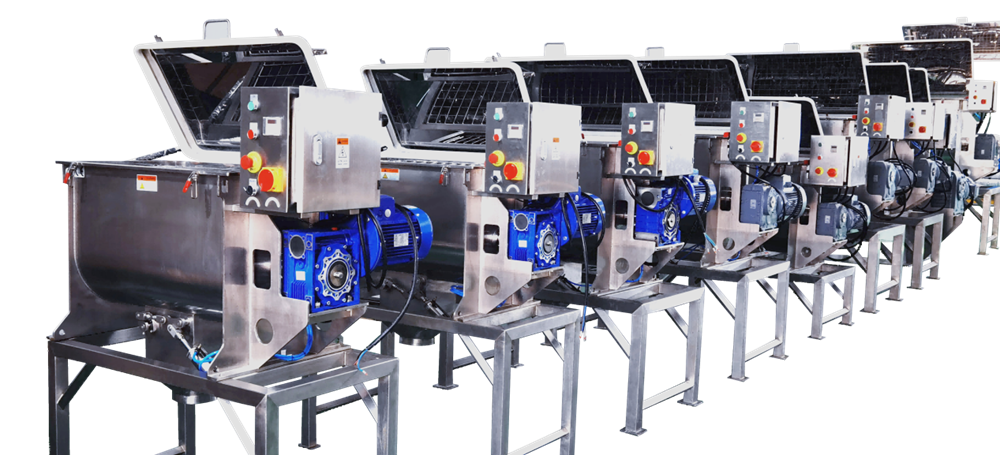
Choosing a suitable ribbon blender is not simply about selecting the biggest machine available. The most economical solution should balance your production target, material characteristics, and mixing efficiency.
If you are a factory manager looking for a ribbon blender to upgrade your production line, the first question that comes to your mind may be: “What size of machine should I buy?”
However, the more important question should be: “How much product do I need to produce per batch?”
Starting from this point, you will find that the characteristics of your raw materials are also a key factor affecting machine selection. Materials with different bulk densities require different mixing volumes, even when the batch weight is the same.
For example, several factories may choose different ribbon blender sizes according to their production requirements and material properties.
A coffee powder manufacturer wants to produce a 3-in-1 coffee powder with a batch capacity of 500 kg. The bulk density of the powder is 0.7 kg/L (700 kg/m³).
How can we choose a suitable ribbon blender based on this information?
Let’s calculate step by step.
The material volume can be calculated by:
Material volume = Weight ÷ Bulk density
So:
500 kg ÷ 700 kg/m³ = 0.71 m³
This means 500 kg of coffee powder occupies approximately 0.71 m³.
However, a ribbon blender should not be filled completely because enough space is required for the ribbon movement and material circulation. Normally, the working volume is around 40–60% of the total blender volume.
Assuming a 60% filling rate:
Required blender volume = 0.71 m³ ÷ 60% = 1.18 m³
Therefore, a 1.5 m³ ribbon blender would be a suitable choice for this application.
This size provides enough space for efficient mixing while avoiding unnecessary investment and excessive power consumption.
The same calculation method can be applied to different materials. For example, lightweight powders such as milk powder, protein powder, or starch may require a larger blender volume compared with high-density minerals or salts, even when the batch weight is identical.
Therefore, choosing a ribbon blender is not only about “how many kilograms you want to mix”, but also about understanding:
- ✓ Your target batch size
- ✓ Bulk density of your materials
- ✓ Required filling ratio
- ✓ Material flowability and mixing characteristics
- ✓ Production frequency
A correct calculation helps you select a machine that achieves stable mixing performance while maximizing your investment value.
Post time: Oct-29-2026