
In the field of powder processing engineering, “Which method should be used for powder mixing?” is a fundamental question throughout the entire process, from laboratory research and development to industrial scale-up and mass production.
From the blending of active pharmaceutical ingredients (APIs) and excipients in the pharmaceutical industry, to the uniform dispersion of metal powders with different particle sizes in powder metallurgy, and the precise mixing of ternary cathode materials and conductive agents in lithium-ion battery production, each application presents different requirements for mixing technology.
As a powder processing equipment supplier, we believe that the selection of a mixing method should not rely solely on experience. Instead, it should be based on a systematic evaluation of material properties, mixing objectives, and process requirements to achieve the desired level of uniformity, efficiency, and product quality.
I. The Physical Essence of Mixing: Synergy and Competition Among Three Fundamental Mechanisms
Any powder mixing process is essentially the result of the interaction and balance among three fundamental mechanisms:
Convective Mixing
Convective mixing refers to the macroscopic movement and exchange of large quantities of material within the mixing vessel. It is mainly characterized by the overall circulation, tumbling, and redistribution of the material bed.
This mechanism plays a dominant role during the initial stage of mixing and determines how quickly large-scale uniformity can be achieved.
Diffusive Mixing
Diffusive mixing refers to the random movement of individual particles across adjacent particle layers. Through continuous particle rearrangement, diffusion gradually improves microscopic uniformity.
Although diffusion is essential for achieving high mixing accuracy, its relatively slow process makes it one of the key factors affecting the final mixing performance.
Shear Mixing
Shear mixing refers to the relative movement and rearrangement of material layers caused by velocity differences within the powder bed.
Shear forces can effectively break up powder agglomerates and improve dispersion. However, excessive shear may cause particle damage, size reduction, or unwanted changes in material properties, especially for shear-sensitive products.
Therefore, effective powder mixing equipment design requires a proper balance and combination of these three mechanisms according to the characteristics of the material and the desired process outcome.
II. Technical Principles and Application Limits of Mainstream Mixing Methods
2.1 Diffusion-Convection-Dominated Type: Rotating Vessel Mixers
Technical Principle
Rotating vessel mixers achieve mixing by rotating the vessel around a fixed axis. During operation, the powder repeatedly undergoes a cycle of lifting, falling, separation, and recombination under the influence of gravity.
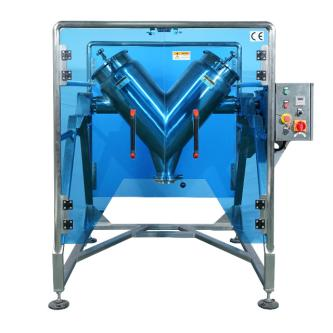
A typical example is the V-type mixer, where the V-shaped vessel structure continuously divides and recombines the powder during rotation, creating effective diffusion and convective mixing.
The repeated movement of materials between different areas of the vessel gradually improves mixing uniformity. Under appropriate operating conditions, V-type mixers can achieve excellent blending performance while maintaining a low-shear environment.
Key Advantages
- · No internal mixing blades or agitators, reducing the risk of metal contamination and material accumulation.
- · Extremely low shear force, making it suitable for brittle particles, crystalline materials, and products sensitive to structural changes.
- · Smooth internal surfaces allow easier cleaning and support applications requiring strict hygiene standards, including pharmaceutical production.
Application Limitations
Rotating vessel mixers are most suitable for free-flowing powders with relatively similar particle size and density characteristics.
For powder systems with significant differences in particle size or density, segregation may occur during or after mixing. In such cases, proper control of filling ratio, rotation speed, and mixing time is required to maintain uniformity.
Typical Applications
Typical applications include:
- · Powder premixing for solid pharmaceutical formulations
- · Feed preparation for metal injection molding (MIM)
- · Dry powder premixing for electronic materials
2.2 Convection-Shear Hybrid Type: Forced-Agitation Mixers
Technical Principle
Forced-agitation mixers apply mechanical energy directly to the material through rotating mixing elements installed inside a stationary vessel.
Depending on the agitator design, these mixers can mainly be divided into two categories:
Ribbon Mixers
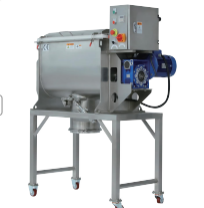
Ribbon mixers use inner and outer helical ribbons to create continuous axial and radial circulation.
The outer ribbon typically moves material from the vessel wall toward the center, while the inner ribbon transfers material from the center toward both ends. This creates a highly efficient convection cycle throughout the mixing chamber.
Due to their strong circulation capability, ribbon mixers are widely used for large-scale powder blending applications and can achieve high mixing uniformity within a relatively short processing time.
They are particularly suitable for:
- · Powder materials with different flow properties
- · Large-volume industrial production
- · Applications requiring consistent mixing performance
Plow Mixers
Plow mixers use specially designed plow-shaped agitators mounted along the main shaft.
During operation, the plow blades continuously lift and disperse the material, creating intensive three-dimensional movement inside the mixing chamber. High-speed chopping devices can also be added to break up agglomerates and improve dispersion.
This combination of convection and shear makes plow mixers suitable for applications requiring both mixing and deagglomeration.
Core Advantages
- · Short mixing time and high production efficiency
- · Suitable for large-scale continuous production
- · Can be equipped with jacketed vessels for heating, cooling, or temperature control during mixing
- · Strong adaptability to powders with different flow characteristics
Key Risks
Because forced-agitation mixers contain rotating components inside the vessel, mechanical seals require careful selection and maintenance to ensure reliable operation and prevent leakage.
In addition, shear-generated heat may increase product temperature during operation. For temperature-sensitive materials, temperature monitoring and cooling systems may be required to maintain product quality.
Post time: Sep-30-2026