
A standard ribbon blender does not come with liquid spray capability as a default feature. The answer is yes—it can be equipped with this function, but it requires an additional liquid addition system as an optional configuration.
When is a liquid spray system necessary?
1
Formulations requiring small amounts of liquid components
When the production process demands uniform incorporation of a small quantity of liquid into a powder-based main material (typically not exceeding 10%–15% of total weight), for example:
- Adding binder solutions for subsequent granulation
- Adding oils, fats, or molasses to improve texture and nutritional value
- Adding colors or flavors to meet product appearance and taste requirements
2
High uniformity requirements
If uneven liquid addition leads to product quality fluctuations—such as inconsistent color shades, uneven distribution of active ingredients, or the formation of agglomerates and wet lumps—then manual pouring or simple drip addition cannot meet the requirements. A spray-based approach must be adopted to achieve fine, controlled liquid dispersion.
3
Extremely small liquid addition quantities
When the liquid addition amount is less than 1% of the total material weight, it is extremely difficult to uniformly disperse such a small volume into a large volume of powder through simple means. In this case, compressed-air-assisted atomization is required to break the liquid into extremely fine droplets to achieve uniform distribution.
How does liquid spray addition work in a ribbon blender?
Basic working principle
The core principle of liquid spray addition in a ribbon blender is to atomize the liquid through nozzles during the mixing process, evenly covering the continuously tumbling material surface.
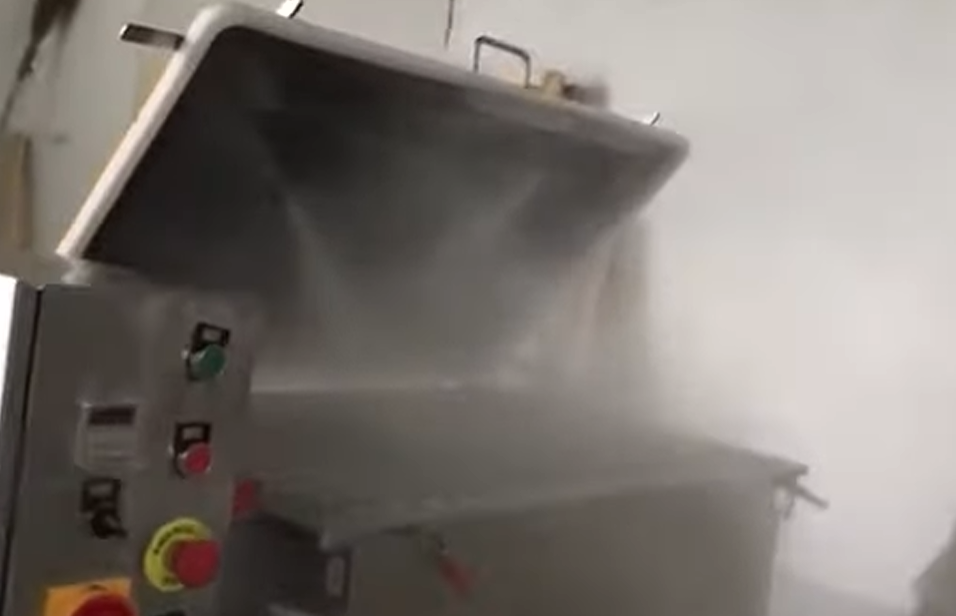
As the ribbon agitator rotates, it pushes the powder material from both ends toward the center (or from the center toward both ends), continuously tossing and turning the material to create a fluidized or semi-fluidized state.
At this point, nozzles installed inside the trough spray the liquid in atomized or fine-stream form, with droplets landing directly on the dynamically moving powder particle surfaces.
Under continuous agitation, the liquid is repeatedly sheared and dispersed, ultimately being uniformly adsorbed onto each powder particle, achieving the goal of uniform liquid-solid mixing.
Equipping a ribbon mixer with a liquid spray system is a well-established optional feature, suitable for powder mixing processes that require the precise addition of liquid components. When selecting the equipment, it is essential to specify the liquid dosage, material properties, and uniformity requirements to ensure optimal mixing results.
Post time: Aug-26-2026