
In the pharmaceutical, food and cosmetic industries, many products are manufactured from powder materials that must be mixed according to precise formulation ratios. The uniformity of this mixing process directly affects the quality of the final product. Mixing refers to the process of altering the movement speed and direction of powder particles under external forces such as gravity and mechanical action, enabling all components to be evenly distributed.

A ribbon mixer achieves efficient and uniform dry powder mixing through its unique structural design. It typically consists of a U-shaped trough and a double ribbon agitator, including both inner and outer ribbons. These ribbons rotate in the same direction but create opposite material flow patterns. The outer ribbon pushes materials from both ends toward the center, while the inner ribbon moves materials from the center toward both ends. This counter-current flow pattern generates continuous circulation throughout the tank, enabling rapid and uniform mixing on a macroscopic level.
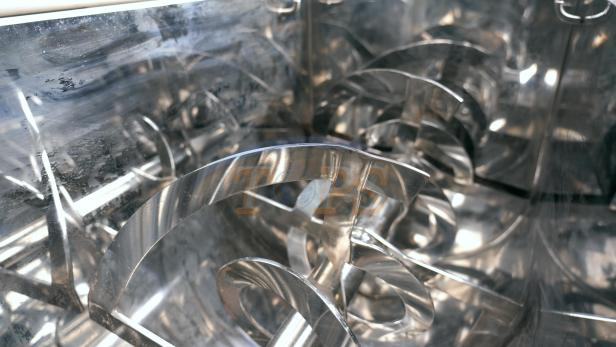
During operation, a ribbon mixer utilizes three main mixing mechanisms:
● Convective mixing: The bulk movement of large volumes of material, allowing particles from different regions to exchange positions continuously.
● Shear mixing: The relative sliding between material layers caused by ribbon rotation, which helps break up agglomerates.
● Diffusion mixing: The random motion of particles at a microscopic level, resulting in a more homogeneous mixture.
Through the combined effect of these mechanisms, dry powders can achieve high uniformity, even when there are differences in particle size and density.
It is often assumed that dry powders have poor fluidity and are prone to segregation, making dead zones and uneven mixing a concern. However, the unique U-shaped trough design effectively minimizes these issues. Typically, the clearance between the ribbon and the tank wall is controlled within 3 mm, reducing stagnant areas and ensuring efficient mixing.
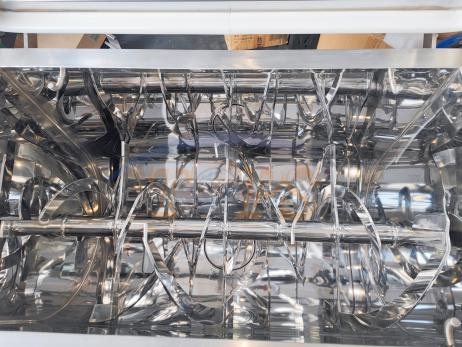
Rotation speed is another critical factor in dry powder mixing. Excessively high speeds may introduce safety risks, such as static electricity buildup or dust explosions. Therefore, ribbon mixers generally operate at relatively low speeds. When necessary, a variable frequency drive (VFD) can be installed to adjust the rotation speed. Lower speeds help maintain stable material flow while ensuring safe and consistent mixing performance.
Post time: May-25-2026