
The answer definitely “YES”.
The blender I mean is the batch blender suitable for powder with powder, powder with liquid, powder with granules. So it definitely suitable for blending the dry things. There are various popular blenders in the market for different usage. I would introduce you some of popular types of blenders that based on special using for different kinds of dry materials.
In industrial dry food processing, selecting the right blending equipment for grains, cereals, nuts, and dried fruits depends mainly on particle size, density differences, and how gently the material needs to be handled. Among the most commonly used solutions are paddle mixers, ribbon blenders, and conical (cone screw) mixers, each offering different mixing mechanisms and performance characteristics.

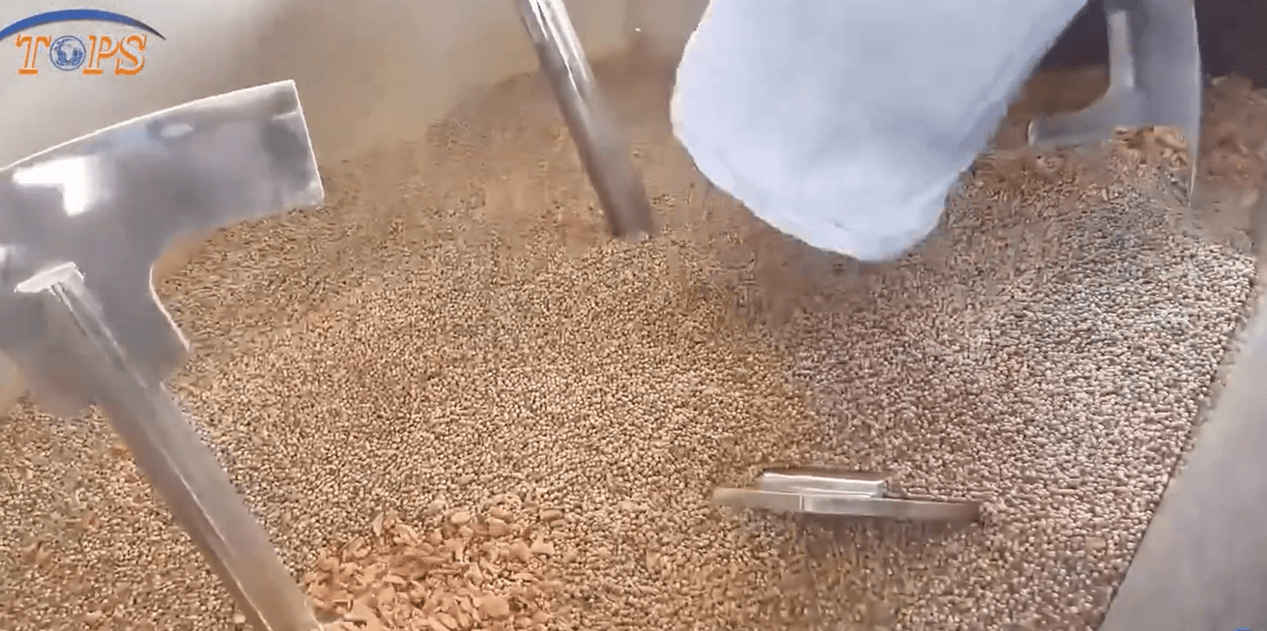
For paddle mixers, the key advantage lies in their low-shear, high-efficiency three-dimensional mixing action. Unlike ribbon blenders, which rely primarily on horizontal convective movement, paddle mixers use specially designed paddles mounted on a rotating shaft to lift, throw, and cascade materials throughout the mixing chamber. This creates a more fluidized, “boiling” motion inside the vessel, allowing ingredients such as small dried cranberries, chopped nuts, raisins, granola pieces, or mixed cereals to distribute evenly without excessive mechanical stress.
This is particularly important for fragile or shape-sensitive products, where maintaining particle integrity is essential. The paddle design minimizes friction and crushing while still ensuring that heavier and lighter particles are continuously reoriented. As a result, paddle mixers are widely used in snack food, breakfast cereals, and functional food blends where uniform distribution is required without damaging appearance or texture.
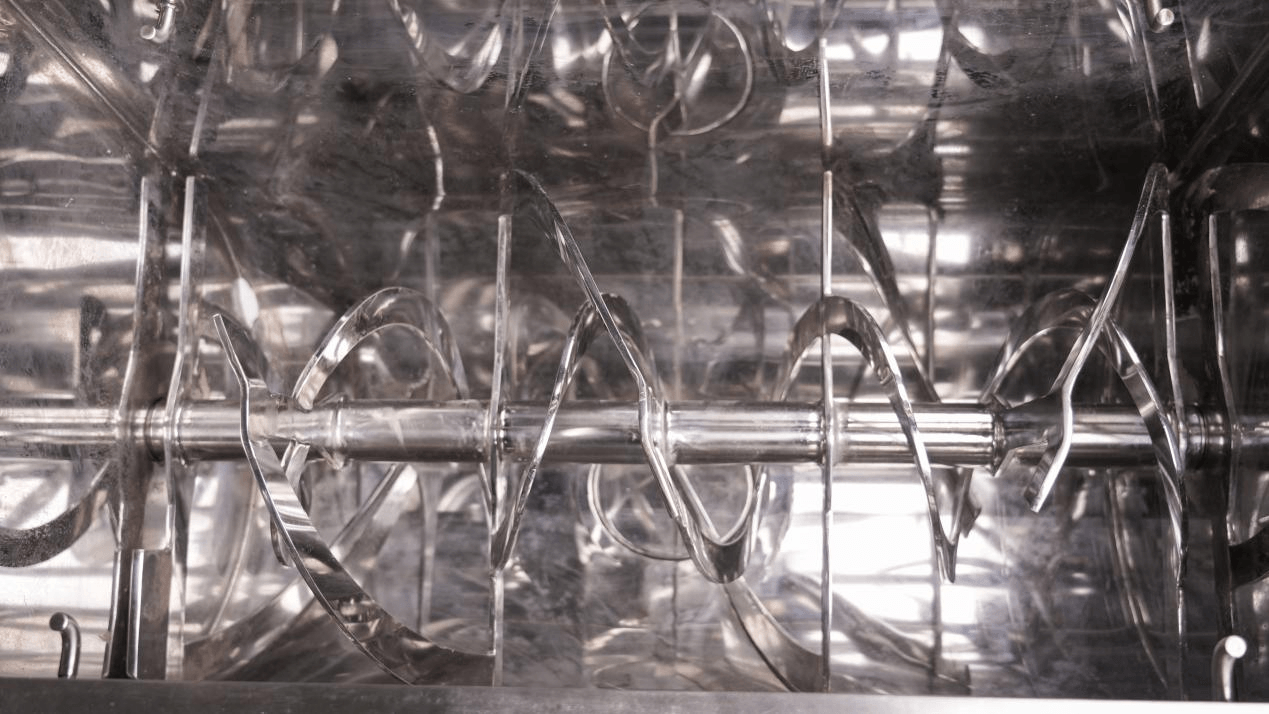
In comparison, the ribbon blender operates through a double helical ribbon agitator that generates strong axial and radial convective flow. It is highly efficient for fine powders and small-particle blending, but when used with larger particles like nuts or dried fruits, the ribbon’s continuous pushing motion can sometimes create localized pressure points. This may lead to minor breakage or uneven distribution if particle size variation is significant. Therefore, ribbon blenders are generally more suitable for powder-dominant systems rather than coarse particulate blends.
The conical mixer (cone screw blender) offers a different approach, focusing on gentle, gravity-assisted mixing combined with vertical circulation. A rotating screw or auger lifts materials from the bottom of the cone to the top, where they fall back by gravity. This continuous circulation creates highly uniform blending with extremely low shear. It is especially suitable for delicate products or multi-component blends where ingredient preservation is critical.
For dried fruits and nut mixtures, cone mixers provide excellent results in terms of blend uniformity and product protection, but they typically operate at lower mixing intensity and longer cycle times compared to paddle systems. They are often preferred in premium food applications where quality consistency and gentle handling outweigh production speed.
Post time: Jun-27-2026