
In many industries, creating a high-quality powder product is not simply about combining different ingredients together. The real challenge for manufacturers is how to achieve a uniform mixture and ensure that every portion of the final product contains the correct ratio of each ingredient.
Powder materials often have different characteristics. Some powders are fine and lightweight, such as milk powder, protein powder, and seasoning blends. Others may contain heavier particles, including sugar crystals, minerals, or functional ingredients. Due to differences in particle size, density, and flowability, powders can easily separate during mixing, transportation, or packaging if the mixing process is not properly designed.
So, how do manufacturers mix different powders evenly?
The key is to create enough movement inside the mixer to allow every particle to contact and distribute throughout the entire batch. In industrial production, powder mixing mainly relies on controlled material movement, especially convection mixing, which creates large-scale circulation and helps powders from different areas blend together effectively.
Ribbon Mixer Solutions
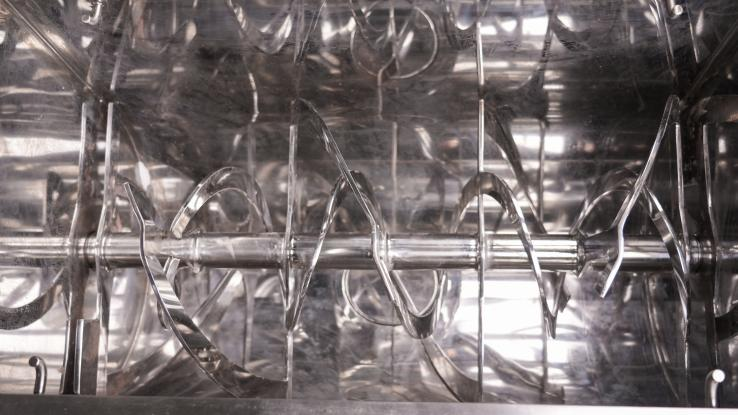
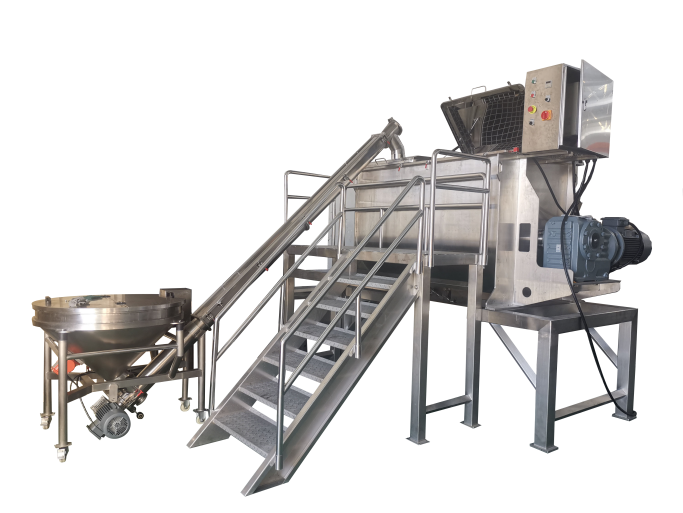
For many dry powder applications, ribbon mixers are one of the most widely used solutions. The specially designed inner and outer ribbons create opposite movements inside the mixing chamber. The outer ribbon pushes materials toward the center, while the inner ribbon moves materials back toward the sides, forming continuous circulation. This mixing method works especially well for powders with good flowability and similar particle characteristics, such as seasoning powders, flour-based products, and many standard dry blends.
However, when powders have significant differences in particle size or density, a different mixing approach may be required. For example, nutritional supplements often contain small amounts of vitamins, minerals, or active ingredients that need to be evenly distributed throughout a large amount of base powder. In these cases, simple blending may not be enough because lightweight and heavy particles can separate easily.
Paddle Mixer Advantages
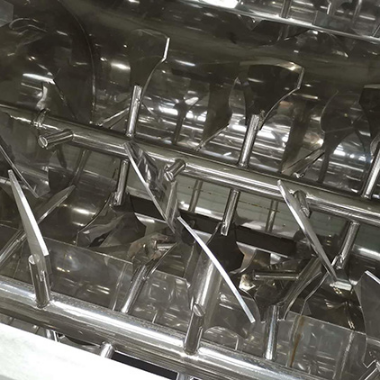
A paddle mixer provides a more three-dimensional mixing movement. Its specially designed paddles lift materials from the bottom and throw them in multiple directions, allowing powders with different properties to mix more evenly while reducing the risk of segregation. This gentle mixing action is also suitable for fragile ingredients that need protection from excessive shear force.
Besides choosing the right mixer, manufacturers also need to consider material properties before production. Fine powders that easily form lumps may require stronger dispersion ability. Larger particles mixed with fine powders usually need better lifting and throwing action to overcome differences in gravity. For ingredients added in very small quantities, a pre-mixing process may be necessary to improve distribution before final blending.
Therefore, achieving uniform powder mixing is not only about using a powerful machine. It requires understanding the characteristics of each ingredient and selecting the correct mixing principle and equipment. By combining suitable mixer design, controlled movement, and proper process planning, manufacturers can achieve consistent quality, stable production, and reliable results from every batch.
Post time: Oct-28-2026