
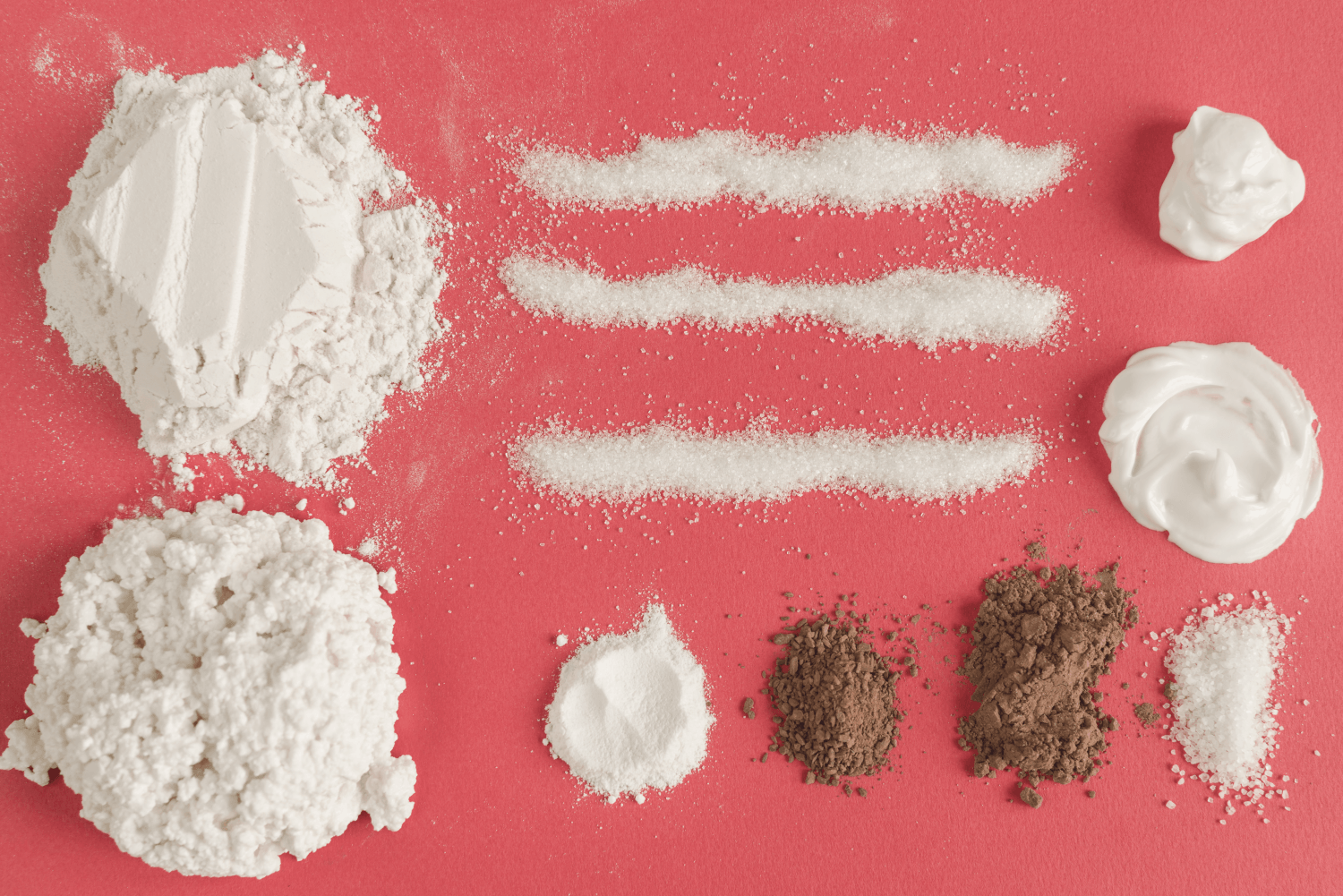
A powder mixer is a mechanical device used to uniformly mix various powdered materials. Its working principle is based on basic mixing mechanisms such as convection mixing, shear mixing, and diffusion mixing, enabling materials to achieve rapid and uniform mixing within a short time.
The mixing of powdered materials is widespread in industrial production, making it a crucial part of the production process. For example, in the production of food, agricultural fertilizers, pharmaceuticals, and daily chemicals, materials of different properties must be mixed uniformly in a certain proportion before undergoing processing to obtain the final product. During production, the uniformity of powder distribution directly affects the final product.
Material mixing refers to the complex motion process in which two or more particles undergo changes in position and velocity under the influence of external forces (mechanical forces or gravity), resulting in the coexistence of multiple particles through relative movement and mutual penetration into their respective particle sets. This process tends to lead to a uniform distribution of the various components. Due to the macroscopic continuity and microscopic discreteness of particles, the mixing motion of particles with different properties exhibits a highly complex chaotic process.
Dry powder mixing refers to the process of uniformly mixing two or more dry powders to ensure consistent distribution of each component. This technology is widely used in: the food industry (flour, spices, beverage powders, premixes, etc.), the pharmaceutical industry (mixing active ingredients and excipients), the chemical industry (fertilizers, detergents, plastic raw materials, etc.), and the feed industry (mixing grains, vitamins, and minerals).
Powder mixing typically relies on the synergistic action of three processes: convection, shearing, and diffusion.
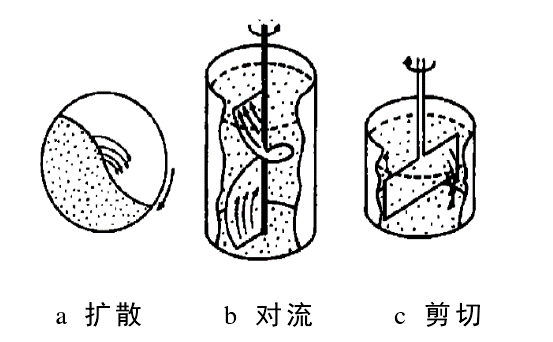
Convective mixing involves large-scale random movement of powder particles. Under the influence of external forces, powder particles undergo fluid-like convection, moving from one point to another, achieving uniform distribution over a large area.
Shearing mixing involves shearing within powder clumps. Under the influence of external forces, powder particles slip against each other, forming several sliding surfaces within the material. These surfaces mix and blend like thin layers of fluid, continuously shearing the powder to achieve uniform distribution in localized areas.
Diffusion mixing is a localized mixing process between two adjacent particles at the microscopic level. Due to changes in the relative positions of adjacent particles, interpenetration and blending occur, allowing the material to achieve a completely homogeneous mixture.
The mixing process can be roughly divided into three stages: convective mixing, a stage involving both convection and shear, and diffusion mixing.
Stage 1: This stage primarily involves convective mixing, with a rapid mixing speed.
Stage 2: This stage involves the combined effects of convection and shear, resulting in a relatively longer mixing time.
Stage 3: This is the diffusion mixing stage, where the mixture is in equilibrium between mixing and separation, with the degree of homogeneity fluctuating around a certain value.
Post time: Jun-06-2026