
In powder mixing equipment, the ribbon mixers is widely used due to its simple structure, wide applicability, and low cost. However, it is not a universal model. When dealing with special materials, high-precision processes, and large-scale continuous production, it has obvious limitations. Understanding these shortcomings can help customers select the right equipment and avoid making mistakes.
1. The mixing speed is slow, and the efficiency is lower than that of the dual-axis paddle blender.
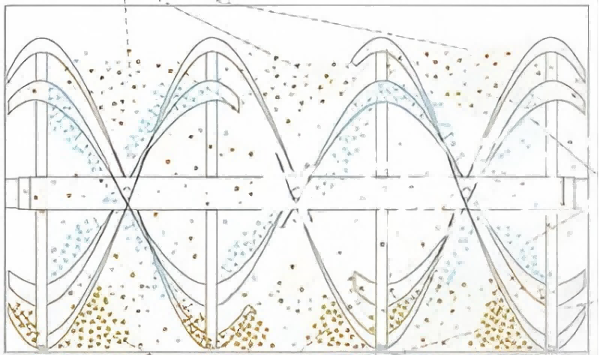
The ribbon blender achieves mixing through unidirectional convection circulation, and its overall movement speed is relatively slow.For factories that pursue high production capacity, quick batch changeover, and continuous production, it will limit the overall efficiency.In large-scale production, the time cost is significantly higher.
2. It is prone to layering when dealing with materials with extremely different densities.
When there are components with significant differences in weight (such as metal powder, heavy minerals + light powder), the convection intensity of the ribbon blender is insufficient to stabilize and lock the particles.This may lead to layering, floating, and sinking phenomena.
For materials with a proportion of less than 1% such as trace additives, color powder, and fragrance, the uniformity is difficult to reach ultra-high precision.
It cannot be compared with the "gravity-weighted mixing" effect of the dual-axis paddle and plow blade blender.
3. Materials with high viscosity and prone to sticking to the wall are difficult to mix evenly and are difficult to clean.
The ribbon structure belongs to a unidirectional push type, and it is not suitable for high-viscosity, damp, and easily agglomerated materials:
The materials are prone to stick to the gap between the ribbon and the barrel wall, forming dead corners.
The agglomerated blocks cannot be fully dispersed, and the mixing uniformity decreases.
During material changeover, the cleaning time is longer, and it is not as convenient as the plow blade and non-axis paddle type.
4. The mixing effect significantly decreases at a low filling rate.
The ribbon blender relies on the mutual compression and convection of the materials, so the optimal filling rate is usually between 40%–70%. If the batch size is too small (<35%–40%), the ribbon cannot hold the material and may cause idle mixing.It is less suitable for small-batch, multi-variety flexible production.
5. It cannot achieve true "high-speed dispersion".
The ribbon blender mainly uses convection mixing, and the shear force is weak:
It has limited effect on materials that need to be dispersed into agglomerates, crushed, or broken.
It cannot complete strong shear dispersion like high-speed mixers or plow blade mixers.
It is not suitable for processes that require simultaneous breaking, dispersion, and modification.
6. It is not suitable for continuous, uninterrupted 24-hour high-load operation.
The ribbon blender is a batch-type intermittent equipment:
Long-term high-load operation will cause faster fatigue of bearings, seals, and the ribbon, and it cannot achieve uninterrupted production line production like continuous mixers. The automation connection is more difficult, and the renovation space is limited.


7. The floor space is relatively long, and it requires space for the factory.
The ribbon blender has a horizontal long-tube structure: it is longer and requires more lateral space. The installation in a factory with narrow space and a compact layout is restricted, and it is less space-saving than the vertical mixer.

The spiral mixer is stable, versatile, and offers good cost performance. It is suitable for conventional powders, medium precision, medium to small production capacity, and scenarios with a budget-friendly requirement. However, it has a slow mixing speed, weak shearing effect, prone to stratification, poor filling rate performance, and high residue. Under the demands of high precision, high viscosity, high production capacity, continuous operation, and strong dispersion, it is not the optimal choice.
The key to selecting equipment is not "the best", but the most suitable process. Understanding the limitations of the spiral mixer enables us to help customers make more professional and reliable selection plans.
Post time: May-11-2026