
The handling of powder materials is a fundamental and critical process in modern industrial production, and powder mixing is one of its most common steps.
However, powder mixing is not simply a matter of combining different materials. It involves applying mechanical forces to continuously disperse and rearrange particles until a uniform distribution is achieved. In this process, the structural design and motion of the equipment play a decisive role. As a result, different types of mixing equipment are suitable for powders with varying properties. Generally, mixing machines can be classified into two main categories: container rotary mixers and convection mixers.
Container Rotary Mixers
The key feature of a container rotary mixer is that the entire vessel rotates, causing the powder to tumble and intermix continuously under the influence of gravity. This motion enables thorough blending. Typical examples include:
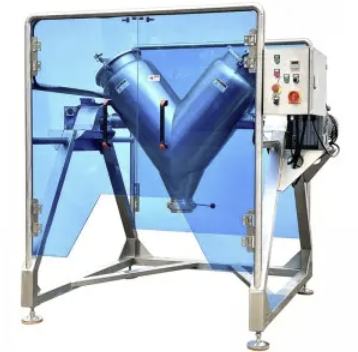
● V mixers: These are commonly used for powders with good flowability, such as food additives or pharmaceutical powders. Their symmetrical design and minimal dead zones contribute to efficient and uniform mixing.
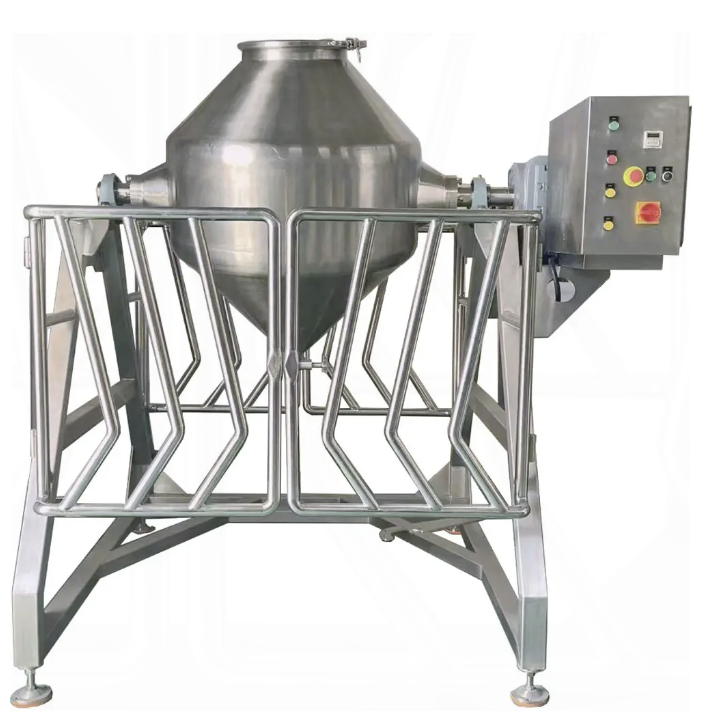
● Double cone mixers: These offer excellent sealing performance and are suitable for handling volatile or environmentally sensitive materials. Their advantages include simple structure and low energy consumption. However, they may have limitations in mixing efficiency for certain materials.
Convection Mixers
Convection mixers are typically equipped with double or multiple ribbons. During operation, the rotating ribbons move powders both horizontally and vertically, creating strong convective circulation and ensuring thorough mixing.
Ribbon mixers are the most representative example and are widely used in industrial applications due to their high efficiency and versatility.
Key Factors in Selecting Powder Mixers
When choosing a powder mixer, several important factors should be considered:
● Material properties: including particle size, density, and flowability
● Mixing requirements: such as desired uniformity and production capacity
● Production environment: including requirements for sealing, hygiene, or explosion-proof design
Different industries have different priorities. For instance: In the food and pharmaceutical industries, equipment must meet strict hygienic standards. In the chemical industry, corrosion resistance and operational safety are especially important.
Importance of Process Parameters
The final mixing quality depends not only on the equipment itself but also on operating parameters such as mixing time, rotation speed, and loading ratio. Insufficient mixing time may result in poor uniformity Excessive mixing time can lead to material segregation or particle degradation. Therefore, in practical production, process parameters must often be optimized through experimentation to achieve the best results.
Post time: Jul-15-2026