
In the industries we come into contact with on a daily basis, such as food, chemical, feed, and medicine, there is a type of machine – it quietly transforms various materials in different states from disorderly to uniform. From the raw materials of bread we eat, to the formula of milk powder we drink, to the dry powder mortar used in construction and the feed used in breeding, all of these are inseparable from its participation. It is the ribbon mixer, a general equipment specifically designed for material mixing.
I. What exactly is a ribbon mixer?
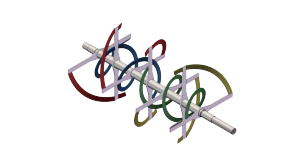
In simple terms, a ribbon mixer is a mechanical device that uses a ribbon structure to rotate and move the materials in a complex manner, thereby achieving uniform mixing of multiple materials. Its core feature is the “ribbon” similar to the screw thread we use at home, but enlarged and designed in a blade shape suitable for material mixing, and installed on the main shaft inside the equipment.
Unlike the household mixer, the ribbon mixer is not designed for liquids but for powders, granular materials, and even paste-like materials (such as fillings, viscous chemical raw materials). It has a large mixing capacity, high efficiency, and is an indispensable “mixing expert” in industrial production. Its shape is mostly horizontal, and there are also a few vertical models. The overall structure is simple, yet it can complete complex mixing tasks.
II. Disassembling the “body components” of the ribbon mixer
To truly understand the ribbon mixer, one must first understand its “body structure”. A standard ribbon mixer mainly consists of five core components, each with its own “exclusive responsibility”, and none can be missing:
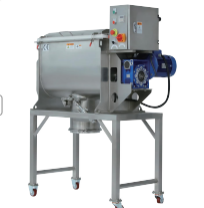
1. The cylinder is the “stomach” of the ribbon mixer, mainly serving to hold the materials that need to be mixed. The material’s type is determined based on the material’s characteristics. For example, in the food industry, stainless steel is used (to prevent contamination), while in the chemical industry, corrosion-resistant materials are used (to handle corrosive raw materials). The cylinder is sealed at both ends to prevent material leakage, and also has an inlet and outlet reserved for the convenience of material entry and exit.
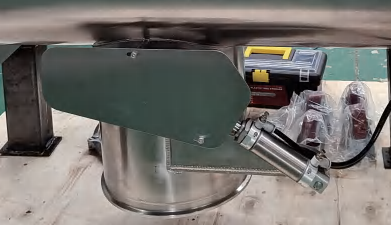
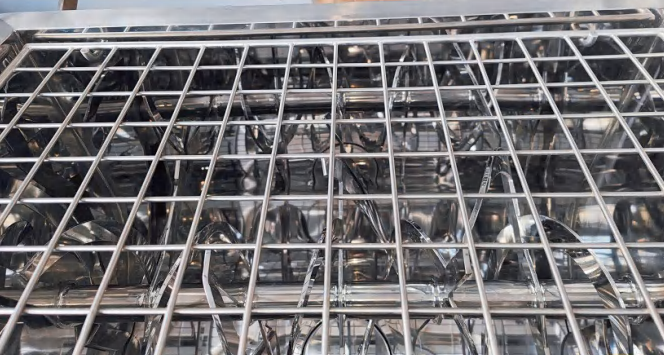
2. The ribbon is the “soul” of the entire equipment and also the origin of its name. It is usually divided into two layers – inner ribbon and outer ribbon – wound around the main shaft, and the rotation directions of the two layers of ribbons are opposite: the outer ribbon is responsible for pushing the materials from both ends towards the middle, while the inner ribbon is responsible for pushing the materials from the middle towards both ends. Through the push and pull, the materials form complex convection and shear movements, thereby achieving uniform mixing.
3. The main shaft is the “transmission shaft” that drives the ribbons to rotate. One end is connected to the motor, and the other end is fixed to the cylinder. When the motor is started, the main shaft drives the ribbons to rotate at high speed, thereby driving the materials to move. The length of the main shaft matches the cylinder, and the material needs to be hard enough to withstand the weight of the ribbons and materials, ensuring long-term stable operation.
4. The motor is like the “heart” of the ribbon mixer, providing rotational power for the equipment; the reducer is responsible for adjusting the speed – the ribbon mixer does not require a very high speed, as too high a speed will cause material splashing and uneven mixing. The reducer can convert the high speed of the motor into a smooth rotation of the ribbons, ensuring the mixing effect.
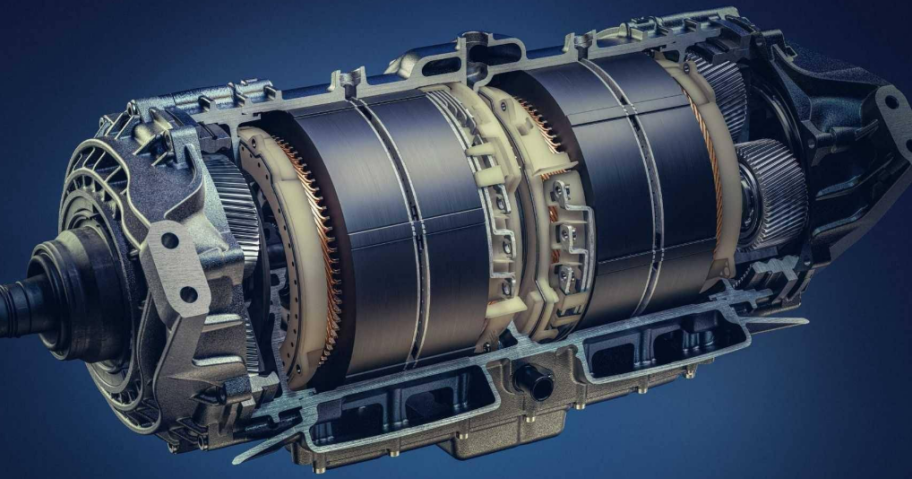
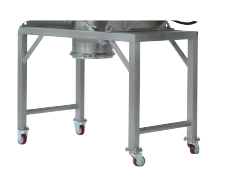
5. The frame is the “support” of the entire equipment, responsible for fixing the cylinder, motor, and reducer, ensuring the equipment operates stably without shaking; the control system is the “brain”, which can adjust the motor speed and mixing time, and some high-end models can also achieve automatic feeding and automatic discharging, with simple and convenient operation.
III. Many people think that the ribbon mixer is just “simple mixing”, but that’s not the case.
Its working principle contains professional industrial design wisdom, and it mainly consists of three steps, efficient and uniform:
Step 1: Feeding. Various materials that need to be mixed are poured into the cylinder through the feeding port. The materials will naturally accumulate at the bottom of the cylinder, and the filling volume is usually controlled at 60%-70% of the cylinder’s volume (not too full, as it will affect the mixing; nor too little, as it will prevent the materials from fully contacting each other).
Step 2: Mixing. Start the motor, and the main shaft drives the inner and outer ribbons to rotate in opposite directions. The outer ribbon pushes the materials from both ends towards the middle, while the inner ribbon pushes the materials from the middle towards both ends. At the same time, the rotation of the ribbons exerts shear force on the materials, allowing the materials to perform complex up-and-down and left-and-right movements within the cylinder, breaking the layered state of the materials and achieving thorough mixing.
Step 3: Discharging. After the mixing process is completed, open the discharge port at the bottom of the cylinder. Under the push of the ribbon, the materials are evenly discharged from the cylinder and enter the next production process. The entire process is efficient and fast, with high mixing uniformity, and can meet the batch production requirements of industrial production.
IV. The application scope of the ribbon mixer is very wide, covering almost all aspects of our lives.
However, we rarely notice its existence in our daily lives. The common scenarios mainly include four types:
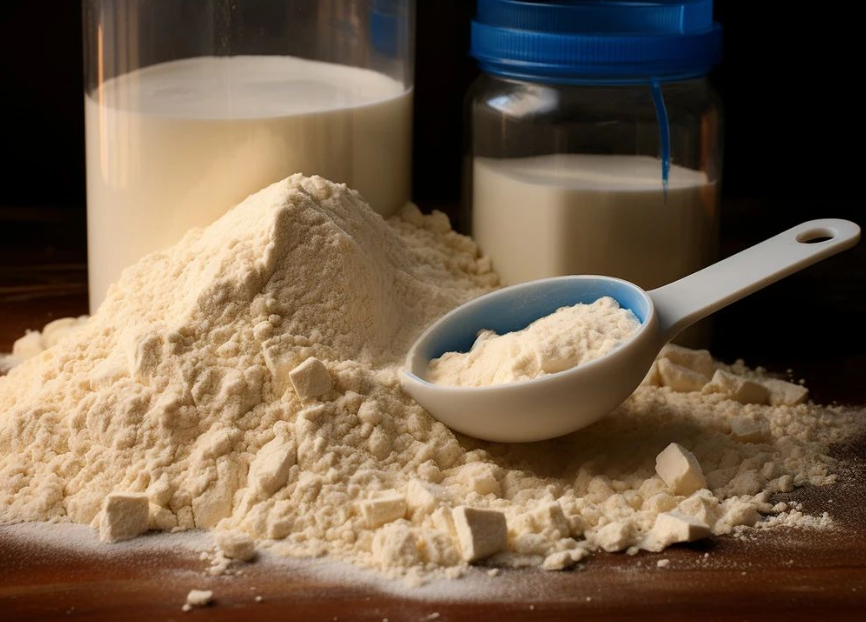
1. Food industry: Mixing of flour with yeast, sugar, milk powder with additives, mixing of fillings (bean paste, meat paste), mixing of cereal and nuts, etc., to ensure uniform food taste and stable formula.
2. Feed industry: Mixing of corn, soybean meal, wheat bran, etc., with vitamins, minerals and other additives, through the ribbon mixer for uniform mixing, to produce balanced nutrition feed, suitable for livestock and poultry breeding.
3. Chemical industry: Mixing of various chemical powders and particles (such as cement, coating raw materials, plastic particles), as well as the stirring of paste chemical raw materials, laying the foundation for subsequent processing and production.
4. Pharmaceutical industry: Mixing of Chinese herbal powder and Western medicine raw materials, to ensure uniform drug components and stable drug efficacy, avoiding deviations in drug efficacy due to uneven components.
The ribbon mixer is not a complicated “high-tech equipment”, but it is the most ordinary yet most powerful helper in industrial production. Through the simple rotation of the ribbon, it transforms various materials from disorder to uniformity, silently supporting the operation of multiple industries such as food, chemicals, feed, and medicine.
The next time you taste bread with a uniform texture, use a fine coating, or see healthy-growing livestock, you might want to think of this “invisible hero” – the ribbon mixer. It is its silent efforts that have made our lives more convenient and better.
Post time: Jun-03-2026