
A dry powder mixer is an industrial piece of equipment designed to achieve a uniform distribution of solid particles through mechanical motion. Its working principle is based on fundamental mixing mechanisms such as convection mixing, shear mixing, and diffusion mixing; these mechanisms ensure a uniform redistribution of particles within the mixture.
There are many types of mixers; this time, we will introduce the paddle mixer.
The paddle mixer is a widely used powder mixing equipment in the food, feed, chemical, and fertilizer industries. Compared to V-type mixers and ribbon mixers, paddle mixers offer advantages such as faster mixing speeds, a wider range of adaptable materials, and less damage to materials. They are particularly suitable for mixing materials with higher specific gravity, larger particle size differences, or those requiring the addition of small amounts of liquid.
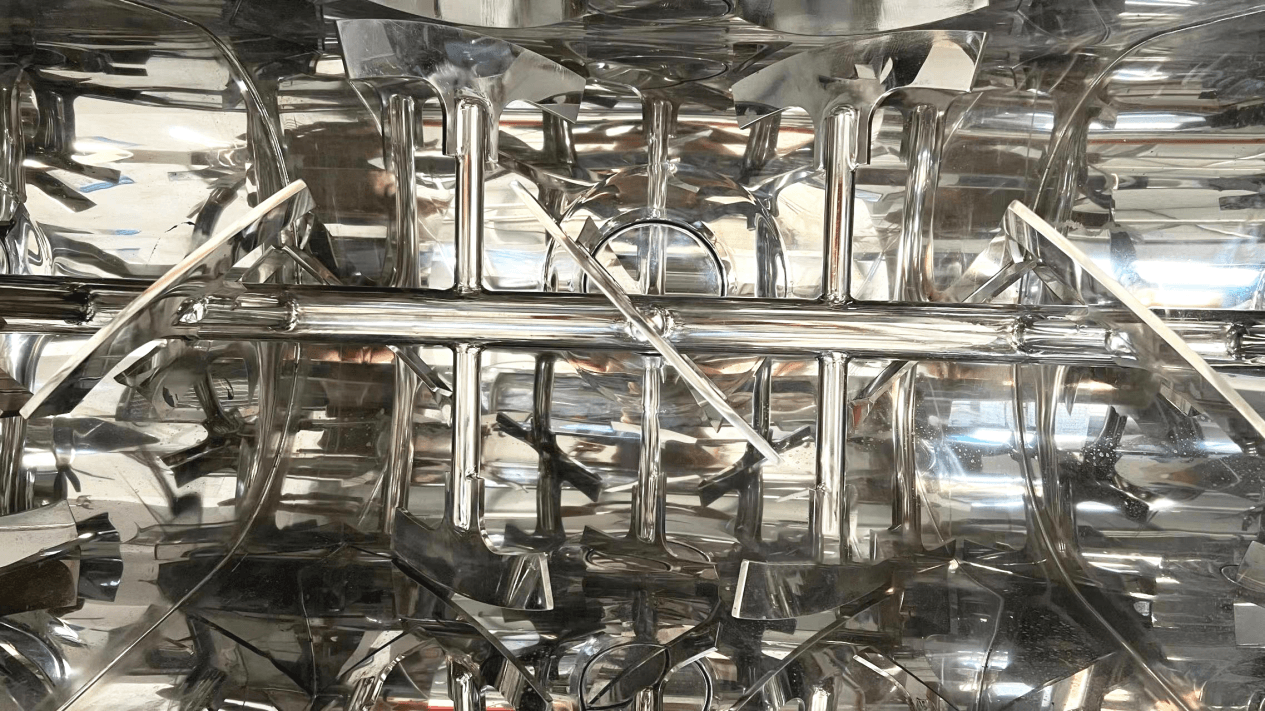
Paddle mixers typically have a horizontal structure, consisting of a U-shaped cylinder, a transmission system, a stirring shaft, and paddles. Depending on the number of stirring shafts, they can be divided into single-shaft paddle mixers and double-shaft paddle mixers. A single-shaft paddle mixer uses a single main shaft to drive the paddles, achieving mixing through lifting, tumbling, and scattering of materials. It has a simple structure, is easy to maintain, and is suitable for small to medium batch production. Twin-shaft paddle mixers utilize two counter-rotating mixing shafts, creating more intense convection and tumbling motions within the machine. This results in higher mixing uniformity in a shorter time, making them widely used in large-scale continuous production.
The working principle of a paddle mixer is to use the thrust generated by the rotating paddles to continuously lift, disperse, and tumble the material, causing it to move simultaneously in three directions: radial, axial, and circumferential, thus creating a three-dimensional mixing state. In a twin-shaft paddle mixer, the two sets of paddles create a fluidized bed-like mixing effect in the center of the machine, suspending and ensuring full contact of the material, significantly improving mixing efficiency. Because the shearing force of the paddles on the material is relatively small, it can reduce particle breakage while maintaining mixing uniformity.
In terms of application scope, paddle mixers are particularly suitable for mixing materials with high density, moderate flowability, or significant differences in composition. For example, in the food industry, it can be used to mix seasonings, milk powder, protein powder, premixed powders, and other products; in the feed industry, it can be used in the production of vitamins, minerals, amino acids, and various premixes; in the chemical industry, it can be used to mix pigments, detergents, resin powders, and various chemical additives; and in the fertilizer industry, it is suitable for the uniform mixing of compound fertilizers, organic fertilizers, and micronutrient fertilizers.
For production processes requiring rapid mixing, high mixing uniformity, and the ability to handle both powder and granular materials, the paddle mixer is an ideal device that balances efficiency and adaptability. When selecting a model, companies should consider factors such as material density, batch output, mixing time, and whether liquid spraying is required to choose a single-shaft or twin-shaft paddle mixer to achieve the best mixing effect.
Post time: Jun-27-2026